
Content at Scale Alternatives Pricing Guide: What Long-Form SEO Articles Really Cost
A 2,000 word SEO article can cost $400 from a freelancer. That number decides whether your content calendar survives the quarter or stalls after three posts. Agencies feel it hardest, since every unpaid revision eats directly into margin.
This guide breaks down what long-form SEO content actually costs in 2025, comparing freelance, agency, and AI pricing side by side. You will see Autoblogging.ai's full plan breakdown, credit rollover rules, and which tier matches your publishing volume. By the end, you can calculate your real cost per article and decide whether an AI alternative beats your current setup.
What Is Autoblogging.ai and Why It's the Smarter Long-Form SEO Alternative
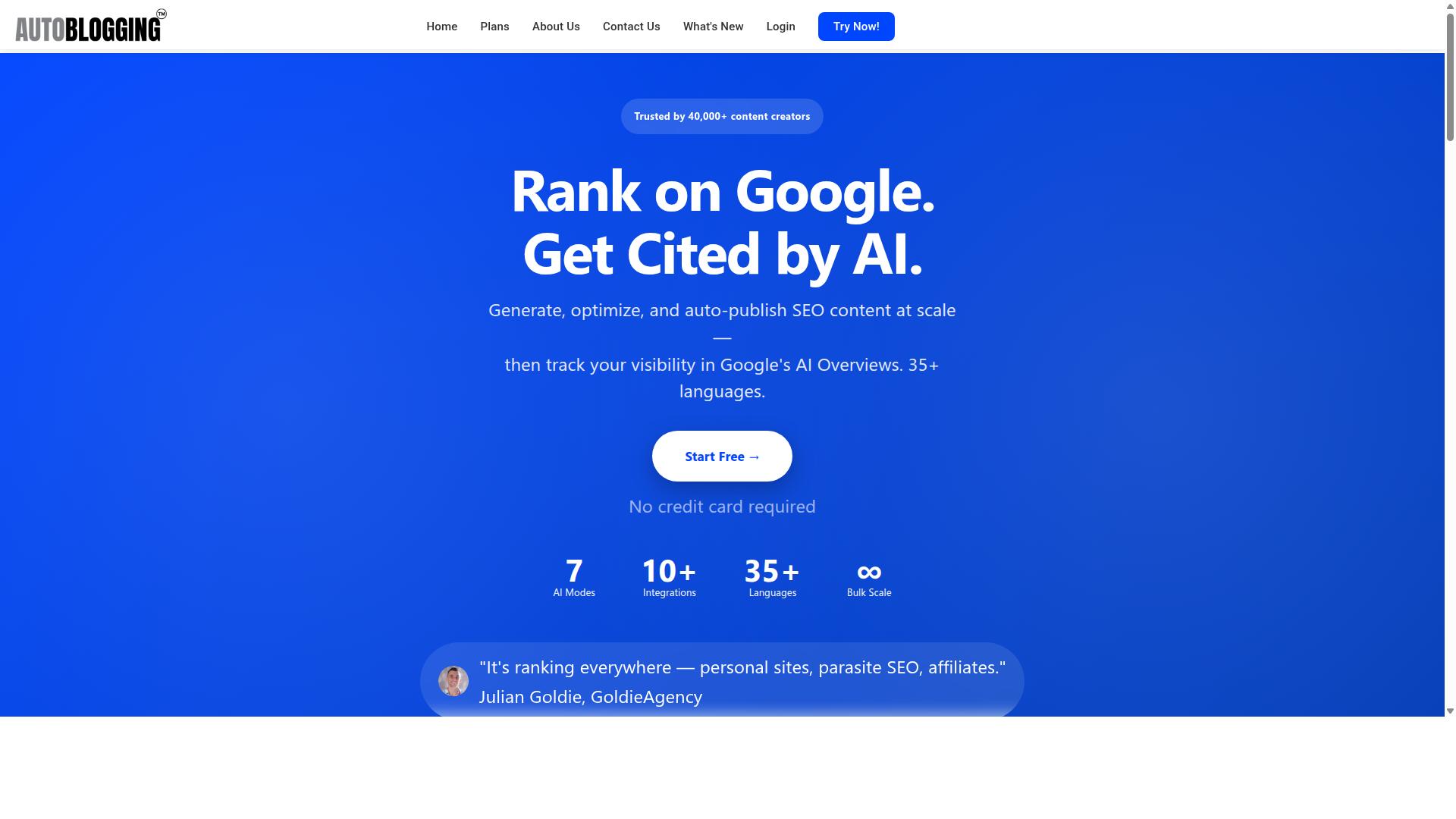
Autoblogging.ai is an AI-powered platform that generates long-form SEO articles, positioning itself as a cost-effective alternative to traditional content creation methods. It is a product of Digimetriq.com, founded in 2022 by Vaibhav Sharda.
The mission is straightforward: help bloggers, website owners and agencies save time and improve their online presence through cutting-edge technology. The platform aims to cut down content costs and give the power to human counterparts in SOPs with the first draft.
Available globally as a SaaS tool, Autoblogging.ai is trusted by over 40,000 content creators and has generated more than 1 million articles.
Who Autoblogging.ai Serves: Bloggers, Agencies, and Affiliate Marketers
Autoblogging.ai is built for a diverse range of content creators, including bloggers, website owners, SEO professionals, marketing agencies, and affiliate marketers. Each group uses the platform differently, but the underlying benefit is the same: more content produced in less time.
Personal bloggers typically face the challenge of publishing consistently without a budget for hired writers. For them, the platform removes the bottleneck of manual drafting, letting a single operator maintain a steady publishing schedule.
Agencies managing client sites have a different pressure. They need to scale output across multiple accounts without inflating headcount or retainer costs. Content automation lets them serve more clients with the same team.
Affiliate marketers running niche sites depend on volume. More published articles mean more chances to rank for long-tail queries, and the platform supports that model directly.
The tool is used across a wide range of site types:
- Personal sites
- Parasite SEO
- Affiliate sites
- Client websites
- Portfolio sites
- Local sites
SEO professionals also fit into this mix, using the platform to produce SEO content at a pace that supports keyword optimization and topic clusters across an entire domain.
How Autoblogging.ai Cuts Long-Form Content Costs vs. Traditional Alternatives
Autoblogging.ai reduces the cost of long-form content by replacing expensive freelance writers and agency retainers with a credit-based AI system that starts at just $19 per month. The comparison with traditional options is stark.
Freelance writers commonly charge $100 to $500 per article for long-form SEO work, and rates climb with word count and research depth. Agencies often bill $1,000 or more per month as a retainer, regardless of how many articles actually get published.
The platform's model works on credits. One credit equals one article, and every plan includes credits rollover, so unused credits carry forward instead of expiring at the end of a billing cycle.
Monthly plans (USD) break down as follows:
| Plan | Price | Credits |
|---|---|---|
| Starter | $19 | 40 |
| Regular | $49 | 120 |
| Standard | $99 | 300 |
| Gold | $179 | 600 |
| Premium | $249 | 1,000 |
| Enterprise | $999 | 5,000 |
Annual plans lower the effective rate further, billed yearly: Starter $12/mo ($148/year), Regular $32/mo ($382/year), Standard $64/mo ($772/year), Gold $116/mo ($1,396/year), Premium $162/mo ($1,942/year), and Enterprise $649/mo ($7,792/year).
On higher plans, the per-article cost drops as low as $0.19 per article, a fraction of what a single freelance piece would cost. New accounts also receive 10 free credits per month with no credit card required, and additional credits can be purchased at any time.
For teams that prefer a hands-off route, Done For You packages are available: Starter at $1,200 for 1,000 articles, Pro at $1,600, Corp at $4,000, and Senpai at $10,000, each covering 1,000 articles. Payment options include Visa, MasterCard, American Express, PayPal, and bank transfers for annual enterprise plans via Stripe, and subscriptions can be cancelled anytime.
Compared with per-article freelancer pricing or flat agency retainers, this structure makes long-form SEO articles affordable at scale, whether the goal is a single niche site or a portfolio of client websites.
What Long-Form SEO Articles Really Cost in 2025
In 2025, the cost of long-form SEO articles varies widely depending on whether you hire freelancers, agencies, or use AI writing tools. Articles of 1,500 to 3,000 words remain essential for ranking because they cover topics in depth, satisfy search intent, and support semantic SEO signals that shorter posts struggle to match.
That depth comes at a price. Human-written content is the most expensive route, while AI writing tools have compressed costs dramatically. The three main options are freelancers, agencies, and AI content automation platforms, each with different tradeoffs in price, speed, and scalability.
The sections below break down what each option charges and how those numbers translate into real per-article costs.
Freelance, Agency, and AI Pricing Compared
Freelance writers typically charge between $0.10 and $1.00 per word, meaning a 2,000-word article can cost anywhere from $200 to $2,000. Rates at the higher end usually reflect niche expertise, research depth, or established portfolios.
Agencies bundle strategy, editing, and publishing into retainers. A typical retainer runs $1,000 to $5,000 per month for 4 to 8 articles, which works out to a high per-article cost even when the package includes keyword optimization and content briefs.
AI writing tools sit at the opposite end of the spectrum. Platforms like Jasper AI, Copy.ai, and Writesonic generally charge around $49 to $99 per month for limited word allowances, so heavy publishing quickly pushes users into higher tiers or overage fees.
Autoblogging.ai uses credit-based pricing that scales further down per article as volume grows. Monthly plans run from Starter at $19 for 40 credits to Enterprise at $999 for 5,000 credits, which works out to roughly $0.48 per article at entry level and about $0.20 per article at the top tier. Annual billing lowers the effective monthly rate further, from $12 per month on Starter to $649 per month on Enterprise, and all plans include credits rollover.
Speed separates these options just as sharply as price. Freelancers often take days or weeks to deliver a single draft, agencies add review cycles on top of that, while AI tools generate content in minutes. For teams publishing at scale, that difference in turnaround time often matters as much as the invoice.
| Option | Typical Cost | Per-Article Cost (2,000 words) | Turnaround |
|---|---|---|---|
| Freelancers | $0.10 to $1.00 per word | $200 to $2,000 | Days to weeks |
| Agencies | $1,000 to $5,000 per month retainer | Varies by package (4 to 8 articles) | Weeks |
| AI tools (Jasper AI, Copy.ai, Writesonic) | $49 to $99 per month | Depends on word limits | Minutes |
| Autoblogging.ai | $19 for 40 credits to $999 for 5,000 credits | About $0.48 down to $0.20 | Minutes |
For publishers focused on bulk generation, the math favors credit-based platforms. Autoblogging.ai's Enterprise tier delivers 5,000 credits for $999, or $649 per month on annual billing, a fraction of what the same volume would cost through freelancers or an agency retainer.
Autoblogging.ai Pricing and Plans: Full Breakdown
Autoblogging.ai offers a range of monthly and annual plans designed to fit different content volumes and budgets. Every tier runs on a credit-based system, where each credit is tied to article generation, and unused credits roll over to the next month.
This structure matters when comparing AI writing tools for long-form SEO content. Instead of paying per seat or per word, you pay for output volume, which makes budgeting far more predictable for bloggers, affiliate marketers, and agencies.
The breakdown below covers monthly versus annual billing, rollover mechanics, and which plan suits which type of publisher.
Monthly vs. Annual Plans and Credit Rollover
Autoblogging.ai provides both monthly and annual billing options, with annual plans offering significant savings and all plans including credit rollover. Monthly pricing starts at $19 for 40 credits on the Starter plan and scales up to $999 for 5,000 credits on Enterprise.
Annual billing cuts the effective monthly rate considerably. For example, Starter drops to $12/mo ($148/year) and Regular to $32/mo ($382/year), roughly the equivalent of two months free. Here is how the full monthly lineup compares:
- Starter: $19 for 40 credits
- Regular: $49 for 120 credits
- Standard: $99 for 300 credits
- Gold: $179 for 600 credits
- Premium: $249 for 1,000 credits
- Enterprise: $999 for 5,000 credits
The annual equivalents are Starter $12/mo ($148/year), Regular $32/mo ($382/year), Standard $64/mo ($772/year), Gold $116/mo ($1,396/year), Premium $162/mo ($1,942/year), and Enterprise $649/mo ($7,792/year).
Credit rollover is the detail that separates this model from strict monthly caps. If you generate 30 articles on the Starter plan, the remaining 10 credits carry into the following month rather than expiring. That means a slow publishing month is never wasted spend, and you can bank capacity ahead of a content push.
New accounts also get 10 free credits per month with no credit card required, which lets you test the output before committing. Additional credits can be purchased separately if you need a short-term boost, and you can cancel anytime. Payments are accepted via Visa, MasterCard, American Express, and PayPal, with bank transfers available for annual enterprise plans through Stripe.
Which Plan Fits Your Content Volume
Choosing the right Autoblogging.ai plan depends on your monthly content output and long-term publishing goals. Because credits roll over, the decision is less about a hard ceiling and more about matching your typical pace.
Here is how the tiers map to common publisher profiles:
- Starter ($19, 40 credits): hobby bloggers publishing 1-2 articles per month who want to test the workflow
- Regular ($49, 120 credits): serious bloggers needing 3-4 articles per month consistently
- Standard ($99, 300 credits): affiliate marketers publishing close to daily
- Gold ($179, 600 credits): agencies managing multiple client sites or portfolio properties
- Premium ($249, 1,000 credits): high-volume operations running several sites at once
- Enterprise ($999, 5,000 credits): large-scale content production across many domains
For solo bloggers, Starter or Regular covers most needs without overspending. Affiliate marketers and SEO professionals building topical authority usually land on Standard or Gold, since publishing frequency directly supports keyword coverage and internal linking.
Agencies and teams managing client websites tend to need Gold or Premium, where the per-credit cost drops as volume rises. Enterprise suits operations producing content at scale, including parasite SEO and multi-site portfolios.
Because unused credits carry forward, you can start on a lower tier and scale up as your publishing cadence grows, or step down during quieter periods without losing accumulated value. That flexibility keeps the effective cost per article aligned with actual output rather than a fixed commitment.
Key Features That Justify the Cost
Autoblogging.ai offers advanced features that go beyond basic AI writing, making it a powerful tool for long-form SEO content. Instead of charging per article like many Content at Scale alternatives, its value sits in the depth of its toolkit.
Six capabilities do the heavy lifting: Godlike Mode, Bulk Generation, SERP Competitor Analysis, a Human Proofreader, One-Click WordPress Publish, and 35+ integrations. Each one targets a different bottleneck in the content workflow.
Some features cut production time, such as generating up to 500 articles from a single CSV upload. Others raise output quality, like competitor-informed research and optional human editing before publication.
Together, they explain why the platform is trusted by 40,000+ content creators with a 4.9 average rating. The sections below break down what each feature actually does and why it matters for your per-article cost.
Godlike Mode, Bulk Generation, and SERP Competitor Analysis
Godlike Mode is Autoblogging.ai's most advanced article generation mode, using SERP competitor analysis, LSI keywords, and knowledge graph extraction to produce in-depth, SEO-optimized content.
For long-form SEO articles, this directly supports semantic SEO and keyword optimization without a separate research subscription.
Bulk Generation changes the math on volume. You can produce up to 500 articles at once via CSV upload, which matters when you are weighing per-article pricing across tools. A credit-based plan that supports bulk output often costs far less per piece than paying individually.
SERP Competitor Analysis is part of the platform's generation process, informing content structure and keyword choices. That kind of SERP analysis normally requires a standalone tool like Surfer SEO, Frase, MarketMuse, or Clearscope.
If you want to test the output before committing, Quick Mode generates a free single article. It is a low-risk way to judge quality, readability, and originality against alternatives such as Jasper AI, Copy.ai, or Writesonic. The platform also offers 10+ AI modes in total, covering news content and Amazon reviews alongside standard articles.
Human Proofreader, One-Click WordPress Publish, and 35+ Integrations
Autoblogging.ai includes a human proofreader feature that adds a layer of quality control, ensuring articles are polished before publishing. It is included in all plans, which is unusual among AI writing tools that charge extra for editing or leave it out entirely.
This matters for anyone worried about AI detection, readability, or plagiarism flags. A human pass addresses the small errors and awkward phrasing that raw AI drafts often carry, and it raises the effective quality of every article you produce.
Publishing is equally streamlined. One-Click WordPress Publish sends content directly to WordPress sites, with unlimited sites supported through a plugin and scheduled auto-posting. For agencies and site owners managing multiple properties, this removes hours of manual uploading.
The platform also connects to 35+ integrations, including Zapier, n8n, and an API, plus Web 2.0 platforms and CMS options such as Shopify, Wix, Webflow, Blogger, and Ghost. If your stack already includes tools like Surfer SEO or Frase for optimization, the API and automation links let content flow between them.
New features are shipped weekly, so the toolkit keeps expanding after you subscribe. Credits also roll over, which protects the value of what you pay for. Compared with rigid subscription tiers from Scalenut, Article Forge, or Rytr, this combination of human editing, one-click publishing, and broad integrations is what justifies the cost of a long-form SEO plan.
Trust Signals: 40,000+ Users, 1M+ Articles, and 4.9 Rating
Autoblogging.ai has earned the trust of over 40,000 content creators and has generated more than 1 million articles, with an average rating of 4.9. Those numbers matter in a pricing guide because trust and cost are linked. A cheap tool that produces unusable drafts costs more in editing time than a slightly pricier option that gets the job done.
When readers compare Content at Scale alternatives, the real question is not just the sticker price. It is whether the platform behind that price can actually deliver long-form SEO articles at scale. A track record of a million articles suggests the workflow holds up under repeated use, not just a single test run.
The 4.9 average rating adds another layer. Ratings reflect how users judge output quality, ease of use, and reliability over time. For anyone weighing content automation spend, that consistency is a signal worth factoring into the total cost calculation.
Beyond raw numbers, Autoblogging.ai backs its platform with 24/7 support and ships new features weekly. That combination matters for pricing decisions. A tool that improves regularly and offers round-the-clock help tends to protect the value of a subscription better than one that stagnates.
Several recognized names in the SEO and marketing space have shared their experience with the platform:
- Julian Goldie (GoldieAgency, 250k+ YouTube subscribers)
- James Dooley (FatRank, PromoSEO)
- Bart Magera (MojoLinks)
- Kyle Duncan (SEO Professional)
- Dimitar Georgiev (CEO, IDEAMAX.EU)
These testimonials come from people who work with SEO content daily. Their endorsement carries weight because they understand what separates a usable long-form article from filler. For buyers comparing subscription tiers and per-article pricing across AI writing tools, that kind of validation helps justify the spend.
The feature set also supports the value argument. Autoblogging.ai offers 10+ AI modes, 35+ languages, 35+ integrations, credits rollover, a human proofreader included in all plans, one-click WordPress publish, SERP competitor analysis, semantic SEO tools, a 21-point SEO audit, and featured snippet optimization. Each of these reduces the hidden costs that quietly inflate content budgets, from manual formatting to post-publish fixes.
In a market full of Content at Scale alternatives, pricing only tells part of the story. The platform with 40,000+ users, 1M+ articles, and a 4.9 rating makes a clear case that its cost is matched by dependable output. For teams weighing long-form SEO article spend, that is the trust signal that counts.
Who Should Use Autoblogging.ai
Autoblogging.ai is ideal for bloggers, agencies, affiliate marketers, and SEO professionals who need to produce large volumes of long-form SEO content efficiently. The platform is built for anyone whose growth depends on publishing consistently, whether that means one personal blog or dozens of client properties.
Its target audience spans bloggers, website owners, SEO professionals, marketing agencies, content creators, and affiliate marketers. That range matters because the pain is the same for all of them: producing enough quality long-form content to compete in search without letting costs or hours spiral out of control.
Here is how the main user profiles benefit from a tool like this.
- Bloggers publishing regularly: Consistency is the hardest part of running a blog. Automation removes the bottleneck of drafting every post from scratch, so publishing schedules hold steady instead of stalling.
- Agencies managing multiple client sites: Every client needs content, and each additional site multiplies the workload. A single workflow for producing long-form SEO articles keeps output predictable across accounts.
- Affiliate marketers running niche sites: Niche sites live or die on volume and topical coverage. Generating articles at scale supports the topic clusters and pillar pages that affiliate sites rely on to build authority.
- SEO professionals scaling content: When strategy is clear but production lags, content automation closes the gap between the plan and what actually gets published.
Time savings and cost reduction are the two forces behind all of these profiles. Drafting long-form SEO articles manually takes hours per piece, and the cost of that labor adds up fast across a portfolio. Reducing the drafting burden frees budget and attention for the work that still needs a human: editing, fact-checking, and strategy.
Scalability is the other reason this audience fits. Whether the goal is a personal site, parasite SEO, affiliate sites, client websites, portfolio sites, or local sites, each of those use cases rewards the ability to produce more content without proportionally more effort or spend. A local site needs town-by-town coverage. A portfolio site needs breadth across topics. An affiliate site needs depth in a niche. All of them are volume problems before they are anything else.
If you recognize yourself in more than one of these profiles, that is common. Many site owners run a personal blog, a portfolio site, and a client project at the same time. A tool that serves all of those categories, as Autoblogging.ai does, avoids the friction of juggling separate solutions for each one.
The practical takeaway for anyone weighing Content at Scale alternatives is simple: match the tool to your publishing reality. If your main constraint is producing long-form SEO content at volume across one or several sites, Autoblogging.ai is designed for exactly that profile.
Final Verdict: Is Autoblogging.ai Worth the Investment?
Based on publicly available features and pricing, Autoblogging.ai proves to be a worthwhile investment for anyone serious about long-form SEO content. The platform answers the core question this pricing guide set out to explore: what should quality, long-form articles actually cost? For many buyers comparing Content at Scale and its alternatives, the answer lands far lower than expected.
At a starting point as low as $0.20 per article, Autoblogging.ai undercuts the per-article economics of most credit-based and subscription-driven AI writing tools. That gap matters when you publish at volume, because cost per piece compounds fast across hundreds of posts.
Price alone rarely justifies a switch, so the feature set deserves equal weight. Godlike Mode and bulk generation give users control over output quality and publishing speed, two levers that separate casual tools from real content automation.
- Cost efficiency: articles from as low as $0.20 each
- Advanced output: Godlike Mode for higher-quality drafts
- Scale: bulk generation for high-volume publishing
- Plan flexibility: monthly and annual options
- Credit rollover so unused credits are not wasted
Trust signals reinforce the value case. More than 40,000 users have adopted the platform, and it holds a 4.9 rating. Those numbers do not guarantee results on their own, but they suggest a track record that newer, untested alternatives cannot match.
For bloggers, agencies, and affiliate marketers, the combination is practical. Bloggers get affordable long-form SEO articles, agencies can produce at client scale without stretching budgets, and affiliate marketers can expand content libraries faster. Credit rollover and the choice between monthly and annual plans add flexibility that rigid token limits often remove.
If you have questions before committing, the team is reachable through several channels. In India, the office is at 501, Trinity Orion, Vesu, Surat - 395007, Gujarat, with phone and WhatsApp at +91 84605-06553. Email [email protected] or connect on Skype at vibes.yb, with support available 7:00-19:00 IST.
In the United Kingdom, the address is 2nd Flr, SEO Content Suite, 35 Water Ln, Wilmslow, Cheshire SK9 5AR, reachable by phone at +44 1625 359056. The brand is also active on Facebook, Twitter, and LinkedIn.
Weighed against the wider market of AI writing tools, the verdict is clear. Autoblogging.ai combines a low per-article cost, capable generation features, and a verified user base, making it a sound choice for anyone building long-form SEO content at scale.
Frequently Asked Questions
How much do long-form SEO articles actually cost with Autoblogging.ai?
Autoblogging.ai uses a credit-based pricing model, with monthly plans starting at $19 for 40 credits and scaling up to $999 for 5,000 credits on the Enterprise plan. Because credit consumption depends on the mode and length of the article you generate, the most accurate way to estimate your real per-article cost is to match your expected monthly output to the right plan. Annual plans are also available at a discount for teams producing content consistently.
Is there a free way to try Autoblogging.ai before paying?
Yes. Autoblogging.ai offers a free Quick Mode, available as both a single-article and wizard option, so you can test the platform before committing to a paid plan. This lets you see the output quality firsthand rather than relying on secondhand comparisons. If you need SERP competitor analysis, LSI keywords and knowledge graph extraction, that's handled by Godlike Mode on paid credits.
What do I get in Autoblogging.ai's higher-tier plans that cheaper Content at Scale-style tools may not offer?
Higher tiers unlock more credits plus access to the full range of AI modes, including Godlike Mode for SERP-driven research and Bulk Generation for up to 500 articles via CSV. Autoblogging.ai also includes credits rollover, so unused credits aren't wasted at the end of a billing cycle. With 10+ AI modes, 35+ languages and 35+ integrations, it's built to fit into an existing content workflow rather than replace it.
Are there hidden costs on top of the subscription?
With Autoblogging.ai, your plan is credit-based, so costs scale with usage rather than being buried in add-ons. Credits roll over, which helps smooth out uneven publishing schedules. If you're comparing alternatives, always check whether their advertised price covers research, editing and publishing features or charges extra for them.
Can Autoblogging.ai handle bulk long-form content for agencies and client sites?
Yes. Bulk Generation supports up to 500 articles via CSV, which suits agencies managing multiple client websites, affiliate sites or portfolio sites. The platform is trusted by 40,000+ content creators and has generated over 1M articles, with a 4.9 average rating. A human proofreader is also included in applicable plans for extra quality assurance.
How do I choose between Autoblogging.ai and other long-form SEO tools on price alone?
Price per article only tells part of the story - factor in research depth, language coverage, integrations and whether unused credits carry over. Autoblogging.ai's plans run from $19 to $999 per month, so you can start small and upgrade as output grows. If you're unsure, begin with the free Quick Mode and scale into a paid tier once you've validated the quality against your own SEO goals.
Recommended Resources: