
TaskRio vs Tasks.Bot for Voice and Text Task Creation Software
Your team still creates tasks by typing them out, one by one, on a laptop. Meanwhile, field crews and managers already live inside WhatsApp, sending voice notes all day. The gap between how work gets reported and how it gets logged is costing you hours weekly.
This comparison shows how Tasks.Bot turns voice notes and text messages into assigned tasks with deadlines, then stacks it against TaskRio on setup, field team features, and pricing. By the end, you will know whether the free trial fits your workflow or whether TaskRio serves you better.
What Is Tasks.Bot? Voice and Text Task Creation via WhatsApp
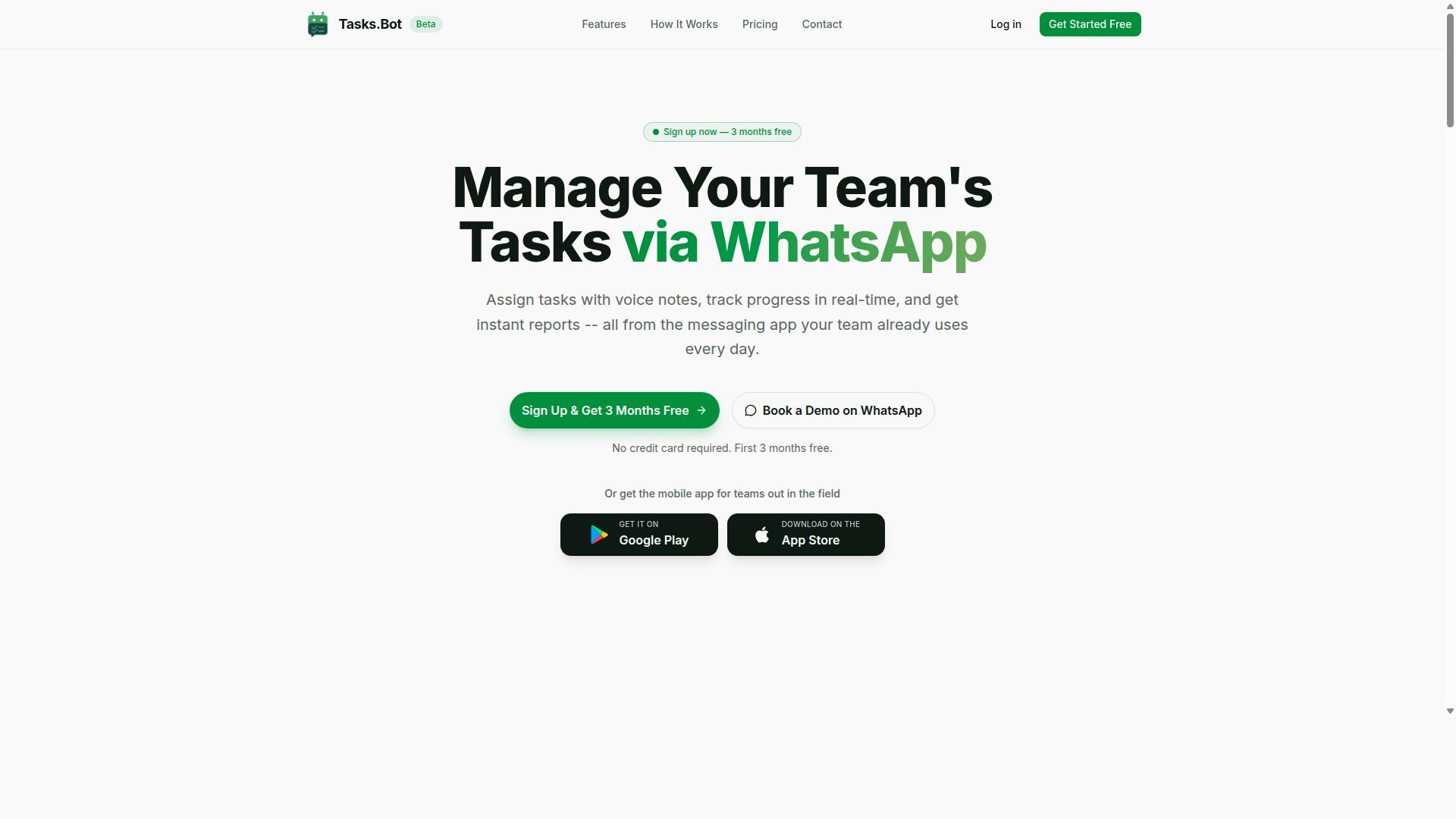
Tasks.Bot is a task management platform that operates entirely within WhatsApp, enabling teams to create tasks using voice notes or text messages without installing additional software. For anyone weighing TaskRio against Tasks.Bot for voice and text task creation, this distinction matters: Tasks.Bot lives where many teams already spend their working hours.
Rather than asking people to adopt a separate task management software interface, Tasks.Bot turns an everyday messaging app into a workspace. Tasks can be assigned, progress can be tracked, and reports can be received inside WhatsApp itself.
The platform supports both voice task creation and text task creation. A team member can speak a task aloud as a voice note or type it as a message, which lowers the barrier for anyone who finds forms and dashboards slow or awkward.
That dual input approach fits how people actually communicate. Some prefer dictation while moving between locations, while others would rather type a quick line. Tasks.Bot accommodates both without forcing a single method.
Accessibility is a core part of the pitch. Because the service runs through WhatsApp, teams that already use the app for coordination do not need to learn a new tool or migrate conversations elsewhere.
Tasks.Bot also offers a mobile app for field teams. This extends the platform beyond office-based users to people working on-site, in transit, or away from a desk.
It is worth noting the current status of the product. Tasks.Bot is currently in beta and offers a free trial period, which gives prospective users a low-risk way to evaluate whether it suits their workflows.
Despite that beta label, the platform is already used by hundreds of teams. That level of adoption suggests the WhatsApp-first model resonates with real organizations, not just early experimenters.
For readers comparing options, the key takeaway is simple. Tasks.Bot is a legitimate, working SaaS solution that treats messaging as the primary interface for task creation, assignment, tracking, and reporting, with a field-ready mobile app alongside it.
How Tasks.Bot Handles Voice and Text Task Creation
Tasks.Bot processes voice notes and text messages using AI to understand user intent and create tasks from messages. There are no forms to fill in, no dropdown menus to navigate, and no separate app to install. Team members simply send a message or a voice note inside WhatsApp, and the system handles the rest.
This approach matters because it removes the biggest barrier to task management software adoption: the effort of entering tasks manually. When capturing a task is quick, people actually do it. Work stops slipping through the cracks because it was never written down.
The workflow has two main stages. First, Tasks.Bot interprets what the user said or typed. Second, it acts on that interpretation by creating, assigning, and tracking the task. The subsections below break down each stage in detail.
AI Natural Language and Voice Note Parsing
Tasks.Bot's AI engine parses natural language from both text and voice notes, identifying task intent, assignees, deadlines, and other entities without manual forms. The NLP engine behind this performs two jobs at once: intent recognition and entity extraction.
Intent recognition answers the question "what does the user want to happen?" A phrase like "create a task" or "remind John" signals a task creation intent. Entity extraction then pulls out the specifics: dates, names, priorities, and locations. For voice notes, speech recognition transcribes the audio first, then the same parsing logic runs on the resulting text.
Consider a simple example. A user says, "Remind Sarah to submit the report by Friday." Tasks.Bot turns that into a task assigned to Sarah with a Friday deadline. No special syntax, no hashtags, no commands to memorize. Users can speak or type the way they naturally talk to a colleague.
This is where Tasks.Bot differs from traditional task management software. Most productivity tools expect structured input: a title field, an assignee dropdown, a date picker. Friction at the point of capture is one of the main reasons to-do lists go stale. Tasks.Bot sidesteps that problem entirely by treating plain language as valid input.
The same parsing works for typed text commands, so teams that prefer typing are not second-class users. Whether someone dictates a voice note while driving or types a quick message between meetings, the result is the same: a structured task with the right details attached.
Automatic Assignment, Deadline Reminders, and Approvals
Once a task is created, Tasks.Bot automatically assigns it to the right team member, sends smart deadline reminders, and routes approvals within WhatsApp. Assignment happens based on mentions in the message or on rules the team has set up. If a name is spoken or typed, that person gets the task.
Reminders are scheduled around the deadline itself, so the right person gets a nudge before the work is due and again on the due date. Because everything runs inside WhatsApp, no one has to check a separate dashboard to stay informed. This matters most for field staff and mobile teams who may rarely open email during the workday.
Approvals follow the same pattern. A manager can request or grant approval through a WhatsApp message, keeping the decision in the same thread as the task. There is no context switching between a chat app and a project management tool.
Tasks.Bot also generates instant reports, giving managers a current view of what has been assigned, completed, or is still pending. Combined with features like tasks on a map and a live day tracker, the system keeps distributed teams visible without adding administrative overhead. The wider product set also includes face-verified attendance, shifts, leave, and hours management, plus Android and iOS apps with push notifications, voice capture, and a home screen widget.
For teams weighing this against alternatives, the core advantage is consolidation. Task creation, assignment, reminders, approvals, and reporting all live in one place that the team already uses every day.
Tasks.Bot vs TaskRio: Where Tasks.Bot Wins on Voice and Text
While TaskRio offers task management with voice and text capabilities, Tasks.Bot differentiates itself through its zero-install WhatsApp integration and specialized field team features. Both tools aim to make task creation faster, but they take different paths to get there.
TaskRio is a legitimate option in the task management software space, and teams evaluating productivity tools should weigh it fairly. Where Tasks.Bot pulls ahead is in how little friction it places on the people receiving and completing work. Tasks.Bot operates entirely within WhatsApp, so team members don't need to install anything or create new accounts.
That difference matters most for teams with field staff, where downloading an app or learning a new interface can slow adoption. Tasks.Bot also uses AI to understand natural language and voice notes for task creation, which keeps the process close to how people already message each other.
The following subsections break down the two areas where Tasks.Bot stands out: setup inside WhatsApp and field-specific tools like face-verified attendance and live GPS tracking.
Zero-Install Setup Inside WhatsApp
Tasks.Bot requires no app installation or new account creation for team members, as it operates entirely within WhatsApp, whereas TaskRio may require users to download an app or sign up separately. For a manager, that difference shows up immediately during onboarding.
With Tasks.Bot, team members simply use their existing WhatsApp to receive tasks, update status, and communicate. There is no invitation email to chase, no password to reset, and no training session on a new dashboard. The tool meets people in an app they already open every day.
Typical task management software often involves several onboarding steps before anyone can act on a task. That friction is manageable for office teams, but it becomes a real barrier for field staff or less tech-savvy members who may not want another login to remember.
Tasks.Bot does offer a mobile app for field teams, but it is optional. Teams that prefer to stay entirely in WhatsApp can do so, while those who want a dedicated app experience have that choice available. This flexibility keeps adoption high without forcing a single workflow on everyone.
Field Team Features: Face-Verified Attendance and Live GPS Tracking
Tasks.Bot includes face-verified attendance and live GPS tracking for field teams, features that are not typically found in general task management tools like TaskRio. These tools matter for businesses where the work happens away from a desk.
Face-verified attendance lets field staff check in by taking a selfie, confirming they are actually on-site rather than logging hours remotely. Managers get a clearer record of who showed up and when, without relying on manual sign-ins or trust alone.
Live GPS tracking gives managers visibility into real-time locations of field staff during work hours. This helps with coordination, route planning, and confirming that tasks are being handled where they should be.
These features connect directly to task management. Tasks can be assigned based on proximity, so the nearest available team member gets the job. For companies running field operations, that combination of attendance, location, and task assignment is hard to replicate with a general-purpose productivity tool.
Tasks.Bot also provides a 3-month free trial with no credit card required, letting teams test how these field features fit their workflow before committing.
Pricing: Tasks.Bot Full Access Plan and Free Trial
Tasks.Bot offers a single 'Full Access' plan with all features included, priced at ₹200 per member per month or ₹1,200 per member per year, with a free trial available. That simplicity stands out in a market where many task management software platforms split capabilities across tiers.
With Tasks.Bot, there is no feature gating tied to a higher price bracket. Every user on the plan gets the same access, whether they rely on voice task creation, text task creation, or both. For teams evaluating productivity tools, this removes a layer of guesswork from the buying decision.
Pricing is listed in Indian Rupees and US Dollars, and the site includes a 'Select currency' option so buyers can view costs in their preferred denomination. Currency should be verified at the point of purchase, since displayed amounts can vary by region and billing setup.
| Plan | Price | Billing Basis |
|---|---|---|
| Monthly | ₹200 per member | Per month |
| Annual | ₹1,200 per member | Per year |
The annual plan delivers a clear saving. Paying monthly would total ₹2,400 across twelve months, while the yearly option costs ₹1,200, a 50% reduction and ₹1,200 saved per member each year.
Because pricing is per member, costs scale in a predictable way. A small team pays for the seats it uses, and a growing team can add members without renegotiating a contract or moving to an entirely different tier.
New users also get 3 months free, with no credit card required and the ability to cancel anytime. This lets individuals and teams test voice commands, text commands, and task scheduling in real workflows before committing budget.
For anyone comparing Tasks.Bot against TaskRio, the practical advice is to check both vendors' current published pricing directly, since plan structures and rates change. What can be said confidently is that Tasks.Bot keeps its model transparent: one plan, one rate per member, and a free entry point.
The service is in beta, which is worth noting for buyers who prefer to plan around long-term stability. A refund policy exists, giving users a documented path if the product does not meet expectations.
Taken together, the structure is easy to reason about. A single Full Access plan, a meaningful annual discount, per-member scaling for team collaboration, a free trial with no card required, and a refund policy add up to a low-risk way to evaluate Tasks.Bot for personal productivity or a shared workflow.
Trust Signals: Beta Status, Encryption, and Teams Already Using It
Tasks.Bot is currently in beta, used by hundreds of teams, and employs encryption to protect data, though it is not yet a fully mature product. For anyone weighing TaskRio against Tasks.Bot for voice task creation and text task creation, that mix of signals matters. Beta status tells you the software is still evolving. Hundreds of active teams tell you it already works for real work.
Trust in task management software rarely comes from a single badge. It comes from several small signals adding up: how open the vendor is about maturity, how seriously it treats data, and whether other people are already relying on it. Tasks.Bot is transparent on all three fronts.
Beta status is a statement of honesty, not a red flag. Many productivity tools stay quiet about how finished they are. Tasks.Bot instead labels itself as in beta, which sets accurate expectations. You know the product is actively developed and that behavior may shift over time.
That transparency cuts both ways. You get an evolving AI assistant built around natural language processing, speech recognition, and intent recognition. You also accept that some edges are still being smoothed. Readers comparing options should treat beta as a maturity signal to weigh, not a reason to dismiss the tool outright.
Encryption is applied to protect data, which matters when voice task creation and text task creation flow through a third-party service. Voice commands and dictation can carry sensitive details: client names, deadlines, internal priorities. A vendor that encrypts data is treating that exposure as a real concern rather than an afterthought.
Data security is a priority for any team adopting workflow automation. When task text and transcribed audio move between a user, a chatbot, and a backend, encryption is the baseline protection users should expect. Tasks.Bot meets that baseline, and the practice fits naturally alongside its role as a task automation layer for team collaboration and personal productivity.
Adoption is its own form of proof. Hundreds of teams already use Tasks.Bot, which means the product is not a concept or a demo. It is handling live to-do lists, reminders, and project management items for groups that expect voice commands and text commands to work.
Social proof of this kind is useful precisely because it is quiet. No single team's story proves a tool is right for you, but a broad base of active users suggests the core workflow holds up across different setups. For a beta product, that is a meaningful signal.
Tasks.Bot also lists a refund policy in its footer, which lowers the risk of trying a product that is still in beta. A stated refund path means an unhappy user is not simply stuck. Combined with the option to book a demo on WhatsApp, it gives prospective buyers a way to ask questions before committing.
- Beta status: the product is still evolving, and the vendor says so plainly.
- Encryption: data protection is built into how the service handles information.
- Hundreds of teams: real usage provides social proof beyond marketing claims.
- Refund policy: a stated path to recover costs reduces commitment risk.
None of this makes Tasks.Bot a finished, mature platform, and the beta label should be read literally. What it does show is a vendor being upfront about stage, protecting user data, and supporting a user base large enough to matter. On trust signals, Tasks.Bot reads as a legitimate, actively used tool rather than a gamble.
Who Should Choose Tasks.Bot for Voice and Text Task Creation
Tasks.Bot is ideal for teams that already use WhatsApp for communication, especially those with field staff who need task management, attendance tracking, and payroll-ready hours. Instead of asking workers to adopt yet another app, it meets them inside the messaging tool they already open every day.
That single design decision shapes who gets the most value from it. The platform is built for practical, mobile-first teams, not for people who enjoy configuring software. If your staff lives in chat threads and voice notes, this fits naturally.
Field operations are the clearest example. Construction crews, delivery drivers, and sales teams on the road rarely sit at a desk, so a dedicated dashboard often goes unused. Voice task creation and text task creation through WhatsApp remove that friction entirely.
Small businesses benefit for a different reason. Owners who cannot justify a heavy project management rollout still need accountability across scattered workers. Tasks.Bot covers that middle ground with attendance tracking and payroll-ready hours attached to the same tasks.
- Construction and trades: crews logging site updates and shift hours by voice while wearing gloves or moving between locations.
- Delivery and logistics: drivers confirming stops, flagging delays, and recording time without leaving the vehicle.
- Field sales: representatives capturing visit notes and follow-ups between appointments.
- Distributed small teams: owners coordinating part-time or remote staff who check WhatsApp far more often than email.
The site notes that hundreds of teams already use the service, which suggests the WhatsApp-first approach resonates well beyond a single industry. The pattern is consistent: work happens away from a computer, so the task tool has to travel with the worker.
Contrast this with tools built around a standalone app experience. Platforms that emphasize dedicated interfaces, integrations, and configuration tend to suit tech-savvy teams working primarily from laptops. Those teams may prefer a richer dashboard and are comfortable managing adoption themselves.
Neither approach is wrong. The question is simply where your people already are. If the answer is WhatsApp, Tasks.Bot removes an entire layer of training and resistance.
A quick way to decide: ask whether your staff would realistically open a new app every morning. If the honest answer is no, a WhatsApp-based workflow will outperform a more sophisticated one that nobody uses.
Tasks.Bot also suits teams that want a virtual assistant feel without the overhead. Voice commands and text commands in a familiar chat window lower the barrier for workers who are not comfortable with formal project management software.
Remote teams spread across time zones gain something similar. A shared chat space keeps updates visible, and the natural language processing behind the scenes turns casual messages into structured records rather than scattered conversation.
Where Tasks.Bot fits best, in short:
- Your team communicates through WhatsApp already.
- Field staff need to log work without a laptop.
- You want attendance and hours tied to tasks, not tracked separately.
- You prefer fast adoption over deep customization.
If most of those describe your operation, Tasks.Bot is the stronger fit for voice and text task creation.
Final Verdict: Is Tasks.Bot the Better Pick Over TaskRio?
For teams that rely on WhatsApp and need voice and text task creation with field team features, Tasks.Bot is a compelling alternative to TaskRio, though its beta status means some may prefer a more established tool.
The decision usually comes down to how your team already works. If WhatsApp is where conversations, updates, and follow-ups already happen, Tasks.Bot fits into that existing habit instead of forcing a new app onto everyone's phone.
If you want a mature, long-standing platform with a broader track record, TaskRio remains a reasonable option to evaluate. Neither choice is wrong, but they suit different priorities.
Key advantages of Tasks.Bot
- Zero-install access: tasks are created through WhatsApp, so there is no separate app for team members to download or maintain.
- Voice and text parsing: both voice task creation and text task creation are supported, which matters for field staff who cannot always type.
- Field team features: the platform is built around the needs of people working away from a desk, not just office-based to-do lists.
- Straightforward pricing: pricing is positioned simply, without the layered tiers that often complicate task management software comparisons.
These points matter most for hands-free operation. A worker on site can speak a task into WhatsApp rather than stopping to open a reminder app, and the same natural language processing approach applies when someone types a short instruction instead.
Trade-offs to weigh
The honest counterpoint is beta status. Features can change, and some buyers prefer a tool that has already settled into a stable long-term release cycle.
TaskRio, being the more established product, may appeal to teams that want a longer history behind their productivity tools. That is a legitimate reason to choose it, particularly for organisations with strict procurement habits.
Neither path removes the need to check how each tool handles your specific task scheduling and team collaboration requirements before committing.
Which should you choose?
Choose Tasks.Bot if your team lives in WhatsApp and needs voice commands plus field-oriented features without extra installation overhead. The combination of voice task creation, text task creation, and a chat-first interface is hard to match for mobile-first crews.
Consider TaskRio instead if maturity and an established release history outrank convenience for your organisation. There is no penalty for preferring a longer-running product when stability is the priority.
For many field and small-team scenarios, though, Tasks.Bot answers the practical question better: can my people create a task in seconds, from wherever they are, using the app already open on their phone?
Next step
You can book a demo on WhatsApp or start a free trial to see how voice and text task creation works with your own workflows.
To reach the team directly, call +91 97143 42522 or email [email protected].
Frequently Asked Questions
What makes Tasks.Bot different from other task creation tools like TaskRio?
Tasks.Bot runs entirely inside WhatsApp, so your team can create tasks with voice notes or natural language without installing anything or creating new accounts. Its AI understands everyday phrasing, and it adds field-ready features like face-verified attendance and tasks on a map. If your team already communicates on WhatsApp, that means far less setup and training than adopting a separate app.
Do I need to install an app to use Tasks.Bot?
No. Tasks.Bot works through WhatsApp, so team members can assign tasks, get reminders, send approvals, and receive reports right in the chat they already use. A mobile app is also available for field teams who need it. This makes it especially practical for field staff who may not want another login or tool to learn.
How does voice-based task creation actually work?
You send a voice note in WhatsApp, and Tasks.Bot's AI interprets it to create the task, including automatic assignment and smart deadline reminders. From there, approvals, automations, and instant reports keep the work moving without manual data entry. It's designed so creating a task feels as quick as sending a message.
How much does Tasks.Bot cost?
Tasks.Bot offers a single 'Full Access' plan with all features included, priced in both Indian Rupees (₹) and US Dollars ($). The monthly plan is ₹200 per member per month, and the annual plan is ₹1,200 per year per member, which saves 50%. You can book a demo on WhatsApp to see it in action before committing.
Can Tasks.Bot handle attendance and payroll-ready hours for field teams?
Yes. Tasks.Bot includes face-verified attendance and live day tracking, which are built for teams with field staff. Combined with task tracking and instant reports, this gives managers payroll-ready hours without chasing spreadsheets. Everything is visible and updated within WhatsApp as the day progresses.
Is Tasks.Bot available in my country, and how do I get started?
Tasks.Bot is a SaaS product available worldwide via WhatsApp and mobile apps, with no country restrictions mentioned. The service is currently in beta, and the easiest first step is to book a demo on WhatsApp. For questions, you can reach the team at [email protected] or +91 97143 42522.
Recommended Resources: